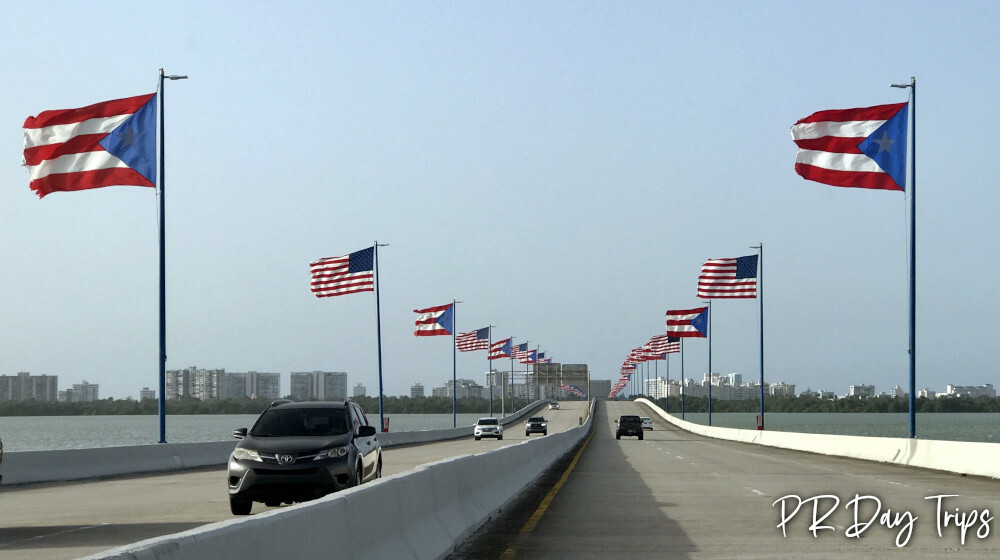
Driving in Puerto Rico
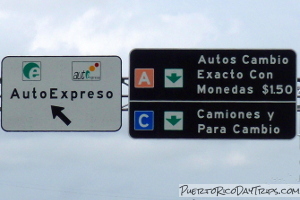
If you are interested in driving around the island visiting places of interest, you will probably end up using the Toll roads. We strongly suggest renting/activating the AutoExpreso Tag from the car rental agency. Currently RT 52, RT 66, RT 22, RT 5, RT 20 and RT 53, and the Moscoso Bridge ONLY accept Autoexpreso.. If your car has an AutoExpreso tag on the window, it will get charged automatically at any toll. If you declined the tag on your rental contract and you use these toll roads, the car agencies usually penalize you with a hefty fee. Make your vacation easier and activate the tag when you get your rental!
Welcome to Puerto Rico! Now that you are here — it is time to explore. Puerto Rico is a relatively large island — 35 miles wide by 100 mile long — compared to other Caribbean islands. And, there is so much to do and see.
Once you decide to venture away from the San Juan metropolitan area, your best bet (and the cheapest way to get around) is to rent a car. You may have heard horror stories about Puerto Rican drivers, but, in reality, it is not that bad! Here are some tips to make your experience driving in Puerto Rico as painless as possible.
Renting a Car: The Basics
There are plenty of national and local car rental companies available at, or near, the airports. Prices vary, so look on-line and shop around. All of the companies need to pick you up in a shuttle to take you to their lot (even though some are on airport property!). On-airport companies have an airport surcharge, so off-airport companies are usually a bit cheaper. Make sure to bring a copy of your insurance information “declarations page” (company name, phone and policy number and the fact that you are covered for accidents in rental cars in Puerto Rico), and of course your driver’s license (no special driver’s license is needed here for tourists).
Rent the smallest car you are comfortable in, a small car is easier to maneuver on small roads and park in tight parking spaces. 4WD vehicles are not needed on the main island of PR — the roads here are fine (though they do have a lot of potholes!). Though for Vieques or Culebra, I do suggest 4WD. Also, to avoid added expenses, make sure you check the parking situation at your hotel or resort. Sometimes there is a fee, or parking is not available at all.
There are number of toll roads in Puerto Rico, with each toll being between $0.75 and $5. Here, we use an electronic toll pass called AutoExpreso, which is similar to (but no the same as) EZPass in the north-eastern US. The car rental places will rent you an AutoExpreso tag with the car. It lets you use toll roads and zip through the tolls. You really will need to have a tag because the toll roads no longer have a cash lane.
You may also want to consider a GPS unit or use Google maps or similar on your phone.
Getting Around
Now that you have your rental car, you are free to explore! There are a few things you need to do before going too far. First, your best bet is to download all the island from Google maps onto your phone, because parts of the island will not have cell service.
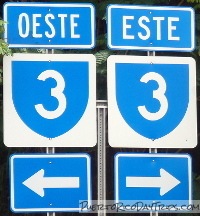
You can use a GPS unit or online map of some kind, which will help a lot. Oftentimes, places in Puerto Rico don’t have addresses that a GPS unit can understand. So having the GPS coordinates of a location, you should be in good shape.
You could always opt to ask someone for directions. Although helpful, many locals give very landmark-specific directions, without using highway numbers or compass direction. If you don’t feel comfortable with that (though they are usually pretty accurate), call your destination for something more specific!
Another thing to take into consideration is how long it will take to drive from point A to point B. The time estimates given by Google Maps or MapQuest are pretty accurate, but I would allow extra time for trips, as accidents and slow-downs happen often.
Rules of the Road
Puerto Rico’s driving rules are almost the same as any US State. We drive on the right side of the road, just as in the States. Road conditions are usually okay, though there will be potholes here and there. Road signs use USA identifiable traffic signs — the shape and colors are the same as in the States, but the words will be in Spanish (see below for some translations). Seat belts are mandatory and must be used by all people in the car. Child seats are mandatory for kids 4 and under, booster seats required for children until 9 years old. Children until 12 years old must ride in back seat. Note- these car seat rules do not apply to taxis or school buses.
Highway road numbers can give you a clue as to what type of road you’re on. Single-digit roads (like Route 1 and Route 3) are the older "main highways" that often have traffic lights every couple of blocks. Double-digit roads (like Route 18 and Route 66) are either newer major highways or toll roads. Triple-digit roads (like Road 186 and Road 191) are smaller, "country roads". Four-digit roads (like Road 9966 and Road 9989) are little, sometimes just 1- 1.5 cars wide roads that you really don’t want to be on unless you know specifically where you’re going.

There are a number of toll roads on the island — Route 66, Route 52, Route 22, RT 20, RT 5 and Route 53 — all with 55-65MPH speed limits. There is also the Teodoro Moscoso Bridge. You need to be aware they only accept the Autoexpreso tag, so you must have approved payment for the tag when renting the car to use these roads to avoid fines at the rental agency. The no stop AutoExpreso lanes are on the left. You can ONLY USE THESE LANES WITH AN AUTOEXPRESO TAG, or you will be charged a HEFTY fine! Some of lanes on the right side of toll plazas are for people who need to recharge their AutoExpreso Tag. Anyone can use this lane, but the line may be longer and slower.
Finally, and this is important, the San Juan area is very congested — there will be traffic that will slow you down. Guaranteed. Leave plenty of time if you need to be somewhere at a certain time and you will be traveling on roads near San Juan. Rush hour going toward San Juan is from 6am to 9am. Rush hour going away from San Juan is 4pm to 7pm. Try to avoid going toward the city in the morning or coming back through the city in the afternoon at those times. The traffic can easily turn a 45-minute trip into a 3-hour nightmare (we know, we’ve done it)!
Expect the Unexpected
As I’ve already said, 99% of the driving rules are the same as in the States. And most people actually follow those rules. But there are a few crazy drivers and there are some habits that are not legal, but occur all the time.
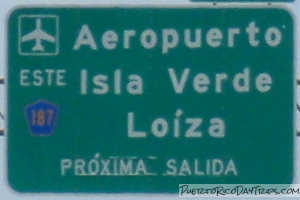
Your best bet is to drive defensively and be alert of the other drivers. Obey the rules as you know them and you should be fine. You will notice many cars with "fender-bender" dents and scrapes, but amazingly, there are relatively few serious accidents. Be alert and be safe.
Some examples of the typical bad driving habits you need to watch out:
- Many people don’t use blinkers/turn signals when changing lanes. They just do it … quickly!
- Even if someone’s turn signal is flashing, don’t necessarily believe it.
- We have a "no passing on the right" rule, but people will pass in any lane (including using the shoulder as a passing lane).
- We also have "keep right except to pass" and "left lane is the fast lane" rules. But people will drive slowly or very fast in any lane.
- Motorcyclists make their own lane in between lanes by riding on the line. Be very careful changing lanes.
- People make U-turns when they have a red light all the time. Don’t do it, you isn’t legal.
- People push the yellow light and end up running the red lights, a lot! Be extra careful at intersections. Don’t jump the green light until you know the other traffic is stopped.
- Be VERY careful early in the early mornings (12a-5a) morning. There is a law that after midnight and before dawn, if you get to an intersection and you have a red light, but no one is coming, you can stop and then proceed with caution. But many people don’t bother stopping and making sure it is safe, they just go, so be extra careful.
- Be very careful around curves on small mountain roads or on small roads that don’t have a lot of traffic. Local drivers who know the curves take their lane in the middle! Go slowly and toot your horn before going around a narrow curve in the mountains, and keep a driver-side window cracked so you can hear others do the same.
- The police drive around all the time with their blue lights on, so don’t panic or pull over unless they turn on the siren.
- Often, people will cut you off and even block a lane if they need to get into traffic. They do not wait for an opening.
- People will stop suddenly and backup if they missed a turn or exit they wanted.
- Don’t assume which direction people are going by the lane they are in. If they are in the wrong lane, they will turn from the lane the are in. You’ll see people turn left from the right-most lane, and other people turn right from the left-most lane.
- pare — stop
- ceda — yield
- cuidado — caution
- salida — exit, both as in a parking lot exit and an exit ramp from a highway
- solo — only, as in the word solo with a left-pointing arrow would mean left turn only
- transito (on a sign with an arrow) — usually means one-way, and sometimes indicates bi-directional traffic flow
- peaje — toll
- autopista — highway or expressway
- norte — north
- sur — south
- este — east
- oeste — west
- hacia — toward, as in Hacia 66 would mean Toward Route 66
- interseción — junction, often abbreviated INT, so INT 3 would mean junction with Route 3
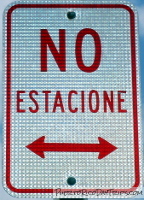
- estacióne — parking
- no estacióne — no parking, also a big E with a slash through it means no parking
- calle — street
- carratera — road
- carril izquierda — left lane
- carril derecho — right lane
- Speed limits are in miles per hour (MPH), but distances on signs are in kilometers (KM).
- Gas is sold (and priced) by the liter. For your own satisfaction, multiply the price posted by 3.8 (or just by 4, it’s easier) to get the (approximate) price per gallon. You usually must pay inside before pumping your gas.
- If you want to go to Old San Juan, plan to park in a parking deck on the perimeter of the city. Try to avoid driving in the center of Old San Juan — it’s a nightmare of narrow, one-way streets. You will drive yourself crazy looking for on-street parking in Old San Juan and most on-street parking there requires a resident permit.
- Park only in designated areas (not just where you see other people parking). Park in the direction of traffic and make sure you are not obstructing traffic in any way (tires should not be on the road side of the white side line). Parking tickets are not a fun souvenir!
Traffic Sign Translations
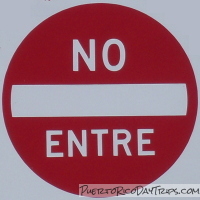
Though we use traffic signs similarly seen in the USA, the writing on traffic signs may be in Spanish, so it is useful to know some translations.
Other Things to Keep in Mind
Final Word
Just be aware of the other drivers around you, take your time driving and try to relax. You are on vacation, after all. Now grab your keys — get out and explore!
Puerto Rico Day Trips LLC assumes no responsibility regarding your safety when participating in the activities described in this article. Please use common sense! If your mother or that little voice in your head tells you that you are about to do something stupid … then don't do it!