PuertoRicoDayTrips.comSponsered by Coqui's Hideaway - www.CoquisHideaway.com
Safety Considerations | FAQ/Help | Privacy Policy | Disclosures | Contact PuertoRicoDayTrips | About PuertoRicoDayTrips
Traveler Health Alert: (updated August 31, 2010) We are in the midst of a dengue epidemic that was declared by the Puerto Rico Health Department on 26 February 2010. Visit the Puerto Rico Health Department "Dengue Watch" web page (in Spanish only) for the latest data on cases across the island. Visit the CDC web site to learn how you can protect yourself from dengue, what the symptoms of dengue are, & what you should do if you suspect that you have dengue. Dengue is completely preventable. Be informed & be safe. Read More →

The Interpretative Trail In Guajataca Forest

Posted on Jan 17th, 2010 by Gwenn • Updated on Apr 1st, 2010

Guajataca Forest Interpretive Trail

The Guajataca Forest (or Bosque de Guajataca in Spanish) comprises 2357 cuerdas (which is about 2289 acres) in Isabela. Being in the Karst Region, it is hilly and the elevation ranges from 500 to 1000 feet above sea level. This low laying area, with its unusual soil, has different flora and fauna than some of the other forests you will visit in Puerto Rico.

The Guajataca Forest is a nice place — some 80 years ago, the land was set aside to become a forest. The walking paths were constructed in the 1930s and 1940s by the Civil Conservation Corps. Areas that needed it were reforested. It was designated a state forest in 1943. It is maintained (surprisingly, fairly well) by the Departamento de Recursos Naturales y Ambientes (DRNA). And to date, it continues to be great place where flora and fauna are protected and people can have a well-maintained place to enjoy nature.

Though this forest has about 25 miles of trails available within its boundaries, the typical visitor will probably use just either Trail #1 (which leads to the Cueva del Viento) and the Interpretative Trail. Both of the trails start out at the same trail head (right by the Information Center). We wrote about the Cueva del Viento in a previous article. This article will give you the information about the Interpretative Trail.

The Interpretative Trail

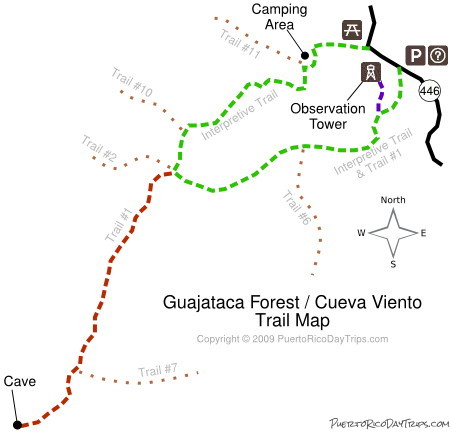
This trail is a circle — so it starts at the Information Center and ends just a few hundred feet up the road at the picnic/camping area. According to the information sheet that the DRNA gives out, this trail it is 3.2 KM long (about 2 miles). However, according to our GPS, it was actually only about 1.3 miles.

This trail is packed earth, with the occasional limestone rock sticking up — but I found it relatively flat and easy to walk. You will enjoy birds and butterflies along the way. This trail also includes a little side trail (about 0.15 miles) that leads to the Observation Tower. In my opinion, this is the only strenuous part of the Interpretative Trail — it is pretty steep and then there are the stairs up in the tower. I found the effort is worth it (for the breeze alone!). But if you can’t (or don’t want to) do it, there is a bench at the turn-off for this side trail where one can sit and wait for the others in their party to go up to the tower.

What makes this an Interpretative Trail is that, along the way, there are 14 marked "stations", which correspond to numbered descriptions in a guide sheet that the people at the Information Center can give you.
Unfortunately, the guide sheet descriptions are all in Spanish — so we translated it below. You may want to print out this article and take it with you — you may find it to be helpful.

The Numbered Stations

Station 1: This is a tree that reaches about 100 feet in height. It is called Casuarina (Casuarina equisetifolia), and it is from Australia and Asia. Many people confuse it with a pine tree. It has long needle-like leaves but it does not have cones. When you get to Station 4, you will be able to compare them. This tree flowers and fruits all year.

Station 2: From this wooden platform you can see the difference between a man-made forest and the natural product. The tree that is in front is a Majo and it was planted around 1973. Also, mostly in the morning, you can hear the songs of some of the 45 species of birds that are found in this forest. Of these, 26 are resident species, 11 migrate and 8 are endemic to Puerto Rico, such as the Carpintero, San Pedrito, Bien-te-veo, Comename and the hummingbird, among others.

Guajataca Forest/Cave Trail Map

Station 3: The Cupey (Clasia rosea) is easy to recognize by its white flowers. Its fruit is green and it turns brown when ripe, it has many yellow seeds inside and its leaves are thick.

Station 4: This tree next to the marker is called Pino Hondureno (Pinus caribbean ondurensis), native of Central America. It is recognized by its fruit, which is a brown cone, and its leaves which look needles. When it is small, it looks very much like the American pines that are used to decorate at Christmas time.

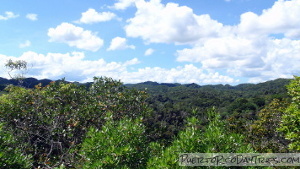
Station 5: You have arrived at the Observation Tower. It was constructed in 1979 and is 750 feet above sea level (you can compare it to a 75 story building). From this point you can appreciate the pretty panoramic view of the forest. The hills in the distance are in the shape of a cone are called magotes and are characteristic of the Karst region. These magotes are separated by wet areas.

Station 6: The Moralon (Cocoloba pubescens) is a tree that grows slowly. Its leaves are rough and can be up to 3 feet in diameter. The wood of this tree is heavy and strong and, so it is often used in construction. Look at the sample piece of cut wood that is at this station.

Station 7: The Maria (Callophyllum calaba) is a tree native to Puerto Rico and is used a lot for shade in urban areas. In forests, the Maria tree can grow up to 65 feet tall but if one keeps it topped, you can control the height but not destroy the sidewalks with the roots. Look at the dark wound-like marks on the bark — this shows up when the tree is an adult and does not represent a problem in the growth cycle.

Station 8: This tree is called Pendula (Citharexylum fructicosum) and it grows up to 40 feet tall. Its bark is cracked and it peels off in long, fine strips. This tree is important — it is a source of food for wildlife like bats and many species of birds. The wood of the Pendula has been used to make furniture and musical instruments like guitars, and violins (among others).

Guajataca Forest Interpretive Trail

Station 9: The soil is made from limestone rock, that is a rock formed from sediments that have accumulated the remains of organisms that contain carbon and calcium. Some examples of this are seashells, corals and clams. These deposits (either whole or in fragments) make various-colored, fine or thick layers. Can you find examples of these layers?

Station 10: The Caoba Dominicana (Swietenia mahagoni) is a valuable tree due to its use — it is used primarily for making banisters. In the spring, for a short time, it appears to be sick or dead because it loses all its leaves, but this is a natural process. The historians indicate that this Caoba was introduced to Puerto Rico more than 200 years ago.

Station 11: These trees in the center of the planted forest are Majo (Hibiscus elatus), a tree that is native to Cuba and Jamaica, but it does very well on our island. Look at the straight growth of the trunk and the heart-shaped leaves. The wood-working artisans use the wood in their work because of its attractive colors. Look at the piece of cut wood and the bench, both are made of Majo.

Station 12: Among the 23 species of trees endemic to Puerto Rico that have been reported in the Guajataca Forest, you can find the Real Palm (Roystonea borinquena), whose height reaches some 60 feet. Its leaves are large and when they are dried — they change to protect the fruit. It flowers and fruits all year. This palm is used very often for the decoration of streets, gardens and parks.

Guajataca Forest Interpretive Trail

Station 13: The stalactites (those that hang from the roof) and the stalagmites (the ones the rise up from the ground) are formations that appear from the accumulation of particles of calcium in caves in the limestone region. These formations grow by a slow geological process during millions of years it takes for the chemical reaction the dissolve the limestone rock.

Station 14: The seed of the Cupey (the tree we discussed at Station 3) sometimes germinated in the branches of other trees. If this happens, it produces aerial roots that grow rapidly and extend until they reach the ground. Then the roots wrap around the other tree and strangle it, eventually killing the tree.

More Info

There is no fee to use the forest trails and facilities.

The forest is open during daylight hours. The information office (located at Route 446 KM 9) may be open daily from about 7am to 3:30pm.

Allow about 1 hour to walk on the Interpretive Trail.

The Guajataca Forest is managed by the DNRA. You can call them at 787-999-2200 for more information.

Take Route 2 to approximately KM 108 and turn onto Route 446 (there is a Reliable Mortgage building on the corner). Follow Route 446 into the forest.

The forest is about 2 hours from the San Juan area and about 1 hour from Rincon.

If you have a GPS, you can punch up these coordinates for the parking area / trailhead on Route 446 (18.420527, -66.965956).

You can locate the Guajataca Forest our Interactive Island Map

PuertoRicoDayTrips.com assumes no responsibility regarding your safety when participating in the activities described in this article. Please use common sense! If your mother or that little voice in your head tells you that you are about to do something stupid ... then don't do it! Read more about Safety →

What Next?

Did you enjoy this article? Why not leave a comment below and continue the conversation, or subscribe to our feed and get articles like this delivered automatically to your feed reader.

Leave Comment

Required Anti-Spam Question

this confirms you're a human user!