
300 Miles of Beaches – How to Find Yours
Water quality is tested every week. To see the current info, check The DRNA water monitoring page or their Facebook page.

Being an island, Puerto Rico has more than 300 miles of beaches, including the out-islands and cays. That’s one beach to explore and enjoy for each day of the year. There is a perfect beach for everyone — it all depends your idea of the perfect beach. Luckily, almost all the beaches in Puerto Rico are open to the general public.
So, now you just have to find "your" beach. But how do you know which beach is "your" beach, when is the best time to visit and if the water at the beach is suitable for swimming?
Here’s a brief primer to help you sort those things out.
Public vs Private Beaches
All beaches in Puerto Rico are public (at least up to the high-tide mark). That means that if you want to visit the beach at a gated resort such as the Wyndham Rio Mar (for example), even if you’re not a guest at the resort, they are supposed to let you.
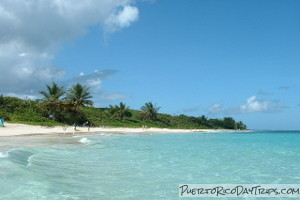
Resorts, hotels and other establishments on seemingly private beaches have to provide beach access to "their" beaches. Having said that, no one says that they have to provide easy beach access.
So, though you have the right to use a public beach at a resort or hotel, the beach access they provide will most likely not be through the hotel lobby. Often, there will be a footpath outside that leads around the hotel to the beach.
Beach chairs, cabanas, beach umbrellas and restrooms provided by a hotel or resort are only for the use of their guests. If the hotel has a bar or other food service, they’ll usually let you buy food/drinks there. If you do that, they might be more willing to let you use some of their other beach amenities.
Balnearios
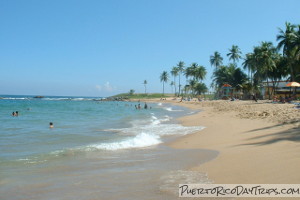
A balneario is a public beach that is maintained and managed by the Puerto Rico National Parks Company (Compañía de Parques Nacionales in Spanish) or by the local town government.
Sometimes referred to simply as the public beaches, the balnearios have paid parking lots and facilities like life guards, restrooms and showers. Some have picnic pavilions and grills. Some have campsites. These are the only beaches that have life guards. Swimming at any other beach is at your own risk.
Balnearios are "open" in the summer (April to August) from 8:30am – 6pm 7 days/week, and in the winter (September to March) from 8:30am – 5pm from Wednesday to Sunday (but they have been known to be open on Mondays and Tuesdays also). Parking costs between $3 and $10 plus tax.
Blue Flag Beaches
The Blue Flag Beach program a voluntary eco-label awarded to over 2800 beaches in 41 countries across Europe, South Africa, Morocco, Tunisia, New Zealand, Brazil, Canada and the Caribbean. The Blue Flag Program is owned and run by the independent non-profit organization Foundation for Environmental Education (FEE).
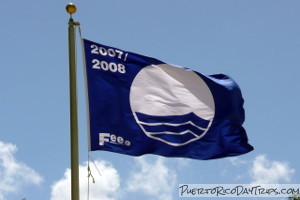
The award of a Blue Flag beach is based on compliance with 29 criteria covering the aspects of Environmental Education & Information, Water Quality, Environmental Management and Safety and Services. Some criteria are imperative while some are guidelines. All Blue Flags are only awarded for one season at a time. If some of the imperative criteria are not fulfilled during the season or the conditions change, the Blue Flag will be withdrawn.
Puerto Rico usually has 4-9 Blue Flags for beaches. You can check Blue Flag web site to see a current map. For 2022/2023, only 2 beaches are Blue Flag Certified: Balneario Puerto Nuevo in Vega Baja and Balneario Escambron in San Juan. Others that are usually designated but didn’t make the list this year….Punta Salinas in Toa Baja, Seven Seas in Fajardo, Balneario Carolina in Carolina, Balneario Monserrate in Luquillo ,Escambrón in San Juan, and Boqueron Beach in Cabo Rojo, and Sun Bay or Sombe in Vieques , Pelican Beach on Caja de Muertos in Ponce, Palomino Island (the beach the El Conquistador hotel uses), Playa Rosada in Lajas, and Flamenco beach on Culebra.
Food & Refreshments
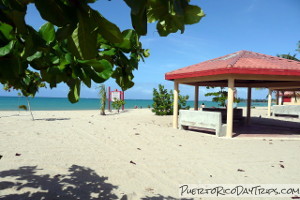
Some beaches have food stands right on the beach or nearby so you can grab a quick bite to eat. At other beaches (Flamenco Beach comes to mind), you’ll find industrious locals who bring their grills to the beach parking area each day to sell local food, like pinchos, empanadillas and alcapurrias.
Of course, you’re always able to bring your own snacks and refreshments with you to the beach. Alcohol is allowed on the beaches — but no glass containers, please!
Safeguarding Your "Stuff"
One question that we hear over and over is "Is it safe to leave my stuff on the beach while I swim or snorkel?". In general, yes … most people are trustworthy and other people enjoying the beach for the day with their families should pose no crime risk. However, there’s always 1 bad apple in the crowd.
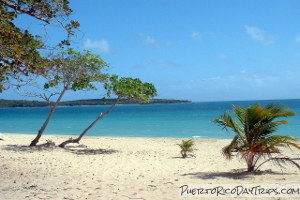
We recommend that you use common sense and take the same precautions that you would take at home.
First, don’t leave valuables (or anything that might look interesting to a thief) visible in your car parked at the beach. Second, don’t bring valuables to the beach. Third, does your entire family really need to go into the water at the same time? Probably not.
Leave someone behind on the beach to keep an eye on your "stuff", just in case, and take turns going into the water.
Beach Water Quality
One thing about Puerto Rico that has a negative effect on the beaches is the population density — we have a lot of residents and visitors on the island. All these people, and their waste products, manage to find a way to the beaches. A visible effect is trash on the beaches and in the water. An invisible effect is bacterial contamination of the water at the beaches.
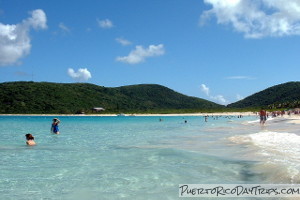
When acceptable values for bacterial contamination are exceeded, swimmers may be exposed to pathogens that cause infections of the skin, eyes, nose and throat, as well as gastrointestinal ailments and diseases.
It’s common practice around the world to test water at beaches for high concentrations of fecal coliform and enterococcus, both of which are bacteriological indicators of possible fecal contamination. Beach water is considered "safe for swimming" if the analysis shows that the concentration of fecal coliform is less than 200 colonies / 100 ml and the concentration of enterococcus is less than 35 colonies / 100 ml.
By now, you’re probably thinking "Yikes! How am I supposed to know if it is safe to go into the water?".
Luckily, the Board of Environmental Quality (JCA, by their Spanish initials) together with the Department of Natural Resources (DRNA, by their Spanish initials) have the responsibility of performing bacteriological sampling and analysis at beaches frequently visited by swimmers. They then provide public notification about the "safety" of the water at each of the tested beaches. Once the results for a beach come up as "not safe", those results remain in effect until the next round of water testing.
This map shows the most recent JCA Beach Water Quality results. If you are interested in the detailed results of the analysis, you can visit the DRNA Beach Monitoring and Public Notification Program web site (all in Spanish) to view the status maps and the numerical testing results for each of the monitored beaches. If there is a yellow flag on the map, that beach is not safe to go into the water.
Beach Water Quality — Our Recommendations
Swimmers should avoid direct contact with any body of water within the first 24 hours after a heavy rainfall event. Heavy rainfall will significantly increase the risk of exposure to potential pathogens.
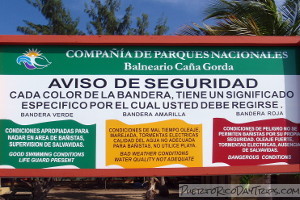
Keep an eye on the flags at the balnearios. They will either be flying a green flag (meaning the water has appropriate conditions for swimmers), a red flag (meaning dangerous conditions and/or there is no life guard on duty), or a yellow flag (meaning the water conditions are not appropriate for swimmers due to weather conditions and/or the quality of the water).

The only beaches that are monitored are those listed and shown on the DRNA/JCA monitoring maps. Not all beaches fly the flags that show you the water quality.
If you want to go swimming at a beach that is not monitored, I would check this list for a beach near the beach you want to go to. If a nearby beach is "unsafe" then the chances that the beach you want to go to might be unsafe, also. After all, there is just one ocean and one continuous beach around the island.
Click on a placename below to view the location on Google Maps ...
- Balneario Boqueron
- Balneario Cana Gorda, parking
- Balneario Carolina
- Balneario Escambron
- Balneario Flamenco, Culebra
- Balneario Monserrate
- Balneario Punta Salinas
- Balneario Punta Santiago
- Cerro Gordo Beach
- Combate Beach
- Crash Boat Beach
- Playa Puerto Nuevo
- Playa Sardinera / Balneario Manuel Nolo Morales
- Seven Seas Beach
- Sun Bay
PuertoRicoDayTrips.com assumes no responsibility regarding your safety when participating in the activities described in this article. Please use common sense! If your mother or that little voice in your head tells you that you are about to do something stupid … then don't do it!